Villa gardens in an arid climate: shade, water and paving that works
Designing a garden for a hot, dry climate means working backwards from comfort. Shade comes before planting, water features need a maintenance plan, and every surface underfoot will be tested at midday in July.
Contents
This article is for villa owners and tenants in the UAE and the wider Gulf who are planning or revising a garden. It covers the decisions that matter most in an arid climate: where to put shade, how to run a small water feature without waste, what to plant in saline soil, and how to make the space usable after dark. The aim is to help you brief a landscape contractor with enough specificity that the result works in August, not just in photographs taken in February.
Start with shade, not planting
A garden in the Gulf is unusable for several months of the year unless it has overhead cover. The first decision is therefore structural: where will shade fall at the hours you actually want to sit outside? Late afternoon and early evening are the realistic windows for most of the year, so the western sun is the one to block.
There are three broad approaches, and they can be combined:
- Trees. A mature neem, sidr or ghaf tree casts dappled shade over a wide area and cools the air beneath its canopy through transpiration. The drawback is time: even a fast-growing species needs several seasons to reach useful height, and roots must be kept away from foundations and drainage. Plant trees early in the project and protect them with temporary shade cloth while they establish.
- Pergolas and solid roofs. A timber or steel pergola with a retractable fabric roof gives adjustable cover over a dining or seating area. A solid insulated roof, finished underneath in plaster or timber, blocks radiant heat more effectively and allows a ceiling fan to be mounted. If the structure is attached to the house, check that the fixing detail does not bridge the damp-proof course or obstruct an existing weep hole.
- Shade sails. Tensioned fabric sails are the lightest and least expensive option. They work well over a play area or a secondary seating corner but need engineered anchor points, typically a steel post set in concrete and a fixing plate on the boundary wall. Fabric degrades under ultraviolet exposure and should be treated as a replaceable component, not a permanent fixture.
Position the shaded zone close to the house so that the walk from the air-conditioned interior to the outdoor seat is short. An outdoor majlis or shaded terrace placed at the far end of a long lawn will go unused in summer because the crossing itself is uncomfortable.
Water features that cool without wasting water
Moving water lowers the perceived temperature of a small courtyard by a few degrees through evaporation. The effect is local: it works within a metre or two of the feature, not across the whole garden. A recirculating system loses water only to evaporation and splash, which in a sheltered courtyard amounts to a modest daily top-up from a float valve connected to the irrigation line.
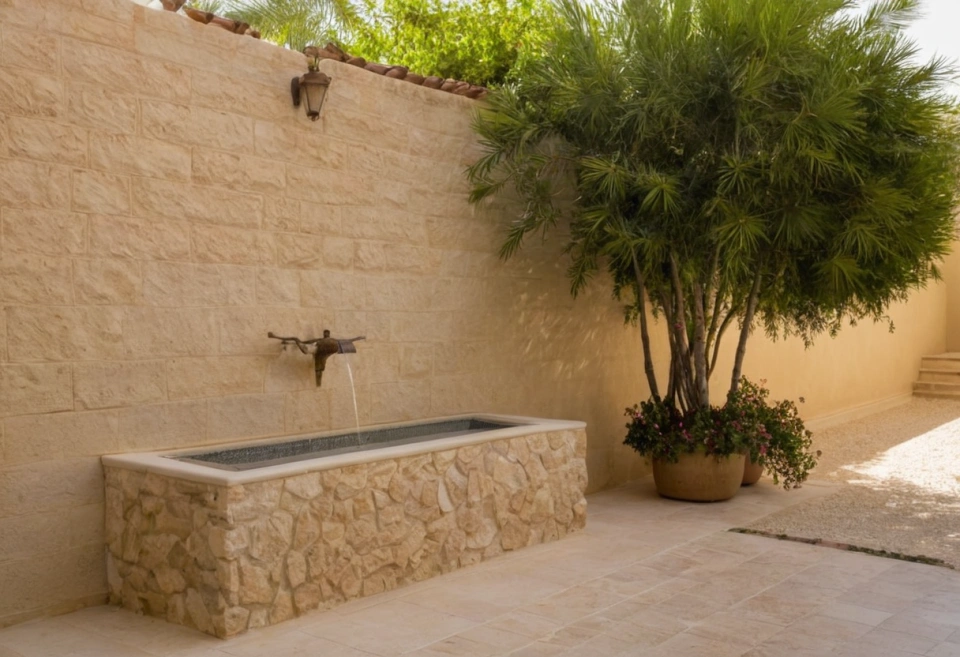
The simplest effective form is a wall fountain: water sheets down a stone or rendered face into a shallow basin, then a submersible pump returns it to a spout at the top. The sound masks road noise, and the wet surface catches light in the evening.
Sizing the pump and keeping it running
The pump must deliver enough flow to wet the full width of the wall evenly. Two numbers matter: the head height (the vertical distance from the water surface in the basin to the spout) and the flow rate at that head. Pump manufacturers publish a curve showing how flow drops as head increases; choose a pump whose curve delivers the sheet of water you want at your actual head, not at zero lift.
Maintenance is straightforward but not optional. In Gulf tap water, calcium carbonate builds up on the pump impeller and the spout within weeks. A monthly routine keeps the feature silent and the flow even:
- Drain the basin and wipe the walls with a stiff brush and diluted white vinegar to dissolve scale.
- Remove the pump, open the impeller housing and rinse the rotor under running water.
- Check the float valve for free movement and clear any debris from the inlet screen.
- Refill, run the pump and listen: a rattling or humming noise usually means scale on the impeller shaft, which a second vinegar soak will clear.
If the fountain sits in full sun, algae will grow on submerged surfaces. A small dose of algaecide rated for recirculating features, added at each water change, keeps the basin clear without harming nearby planting.
Planting that survives heat and salt
Soil in many Gulf villa plots is imported fill, often high in salts and low in organic matter. Irrigation water, whether desalinated mains supply or tanker-delivered, can also carry dissolved salts that accumulate in the root zone over time. The practical response is twofold: choose species that tolerate salinity, and flush the soil periodically with a deep watering that pushes salts below the root zone.
Reliable choices for structure and screening include bougainvillea (which thrives on neglect and blooms harder in poor soil), oleander, tecoma and various palms. For ground-level colour, lantana, portulaca and vinca handle reflected heat from paving. Herbs such as rosemary and oregano survive in raised beds with improved drainage. Avoid plants that need consistently moist, acidic soil: gardenias, azaleas and most ferns will struggle regardless of care.
Group plants by water demand. Put drought-tolerant shrubs on one valve and thirstier ornamentals on another. This avoids overwatering the hardy plants while trying to keep the tender ones alive.
Irrigation that does not waste water
Drip lines laid under mulch deliver water directly to the root zone with minimal evaporation loss. Spray heads lose a significant share to wind drift and evaporation before the droplets reach the soil, and they wet foliage, which encourages fungal spots in the humid coastal autumn. A simple battery-operated timer on each zone, set to run before dawn, cuts consumption further.
Check emitters monthly. Hard water blocks the narrow labyrinth inside a dripper, and a blocked emitter is invisible until the plant above it wilts. Flush the lines at the start of each season by opening the end caps and running the zone for a minute.
Mulch matters. A layer of gravel or shredded bark over the drip lines reduces surface evaporation, suppresses weeds and keeps the soil temperature lower. Inorganic gravel mulch suits the arid aesthetic and does not blow away; organic mulch breaks down and needs topping up but improves soil structure over time.
Paving, boundaries and surfaces underfoot
Dark polished granite or basalt paving reaches temperatures that burn bare feet within minutes of midday sun. Light-coloured, textured natural stone (limestone, travertine, sandblasted granite) absorbs less radiant energy and offers grip when wet from irrigation overspray or a fountain. The choice of stone for coastal homes applies equally outdoors: density, porosity and salt resistance determine how the surface ages.
Leave open joints between pavers filled with compacted sand or a permeable grout. This allows rainwater (rare but intense when it arrives) to drain rather than pool, and it accommodates thermal movement without cracking. A slight fall of one or two degrees towards a planted bed or a channel drain prevents standing water that breeds mosquitoes.
Boundary walls in villa communities are often rendered blockwork, two metres or more in height. They provide privacy but also trap heat and block breeze. If the wall faces west, a climbing plant or a row of tall shrubs in front of it will absorb and re-radiate less heat than bare render. A horizontal timber screen fixed to standoffs, leaving an air gap behind, achieves a similar effect and adds texture.
Lighting the garden for evening use
Most villa gardens are used after sunset for half the year. Lighting should serve three tasks: safe movement along paths, comfortable illumination of the seating area, and accent light on planting or the water feature. Layer these rather than flooding the whole space from a single floodlight.
Path lights at ankle height, spaced so their pools overlap slightly, mark the route without glare. A dimmable downlight under the pergola roof, aimed at the table, gives enough light to eat by without attracting every insect in the neighbourhood. Submersible LED fixtures in the fountain basin turn the water sheet into a luminous plane after dark; choose warm-white rather than cool-white to keep the atmosphere relaxed.
Run all garden lighting on a separate circuit with an astronomical time clock or a photocell, so it switches on at dusk without manual intervention. LED fittings rated IP65 or higher will survive irrigation spray and the occasional sandstorm. Check gaskets annually: fine dust ingress is the main cause of premature failure in Gulf conditions.
Practical next steps
Before commissioning a landscape design, walk the plot at four in the afternoon in summer and note where shade already falls from the house and boundary walls. Mark the spots where you would realistically sit. Photograph the soil surface after a watering to see how quickly it dries and whether white salt crusts appear. These observations give a designer more useful information than a mood board.
Ask your contractor for a written irrigation schedule specifying zones, emitter types, run times and seasonal adjustments. Ask for the pump curve of any fountain pump proposed, matched to the actual head height of the feature. And agree a maintenance visit frequency for the first year: most planting failures and pump seizures happen in the first months, when establishment watering and descaling routines have not yet become habit.