Marble and natural stone in coastal Gulf homes
A practical guide to specifying natural stone where the air carries salt and the water leaves scale. What each stone tolerates, what a sealer actually does, and how finish, joints and cleaning decide whether it ages well.
Contents
This guide is for owners and tenants of villas within sight or smell of the sea, and for anyone writing a brief for a stone floor, bathroom or kitchen worktop. It sets out how marble, limestone, travertine and granite behave in a hot, humid, salty climate, what surface finishes do to grip and glare, what a sealer can and cannot prevent, and how joints and daily cleaning decide whether the stone still looks deliberate in ten years.
Four stones, four different tolerances
Marble, limestone and travertine are all calcium carbonate. They share one weakness: acid dissolves the surface. Lemon juice, vinegar, some limescale removers and acidic bathroom cleaners leave a dull mark within seconds, and no amount of polishing skill at the factory changes that. Granite is a silicate rock. It resists household acids, takes a harder polish and is generally denser, though dark granites show every water spot and fingerprint.
The differences between the three carbonates are mostly about structure. Marble is recrystallised and fairly tight, so it takes a crisp arris and a mirror polish. Limestone is softer and often contains shell fragments and open bedding planes; some varieties are dense enough for floors, others barely suitable for a wall. Travertine is a limestone formed around springs, full of voids. Those voids are either filled at the factory with resin or cement, or left open. Filled travertine reads as a warm, even floor. Unfilled travertine grips better outdoors but holds sand and salt in its pores, and the fill in cheap material can pop out under thermal movement.
Ask for the specific quarry name and bed, not just the colour. Two pallets sold as the same beige travertine can differ in void size, fill quality and thickness tolerance. Request the technical data sheet: water absorption, flexural strength and abrasion resistance. A stone with high absorption used on a coastal terrace will move more moisture and more salt than one laid inside an air-conditioned majlis.
Finish decides grip, glare and how marks read
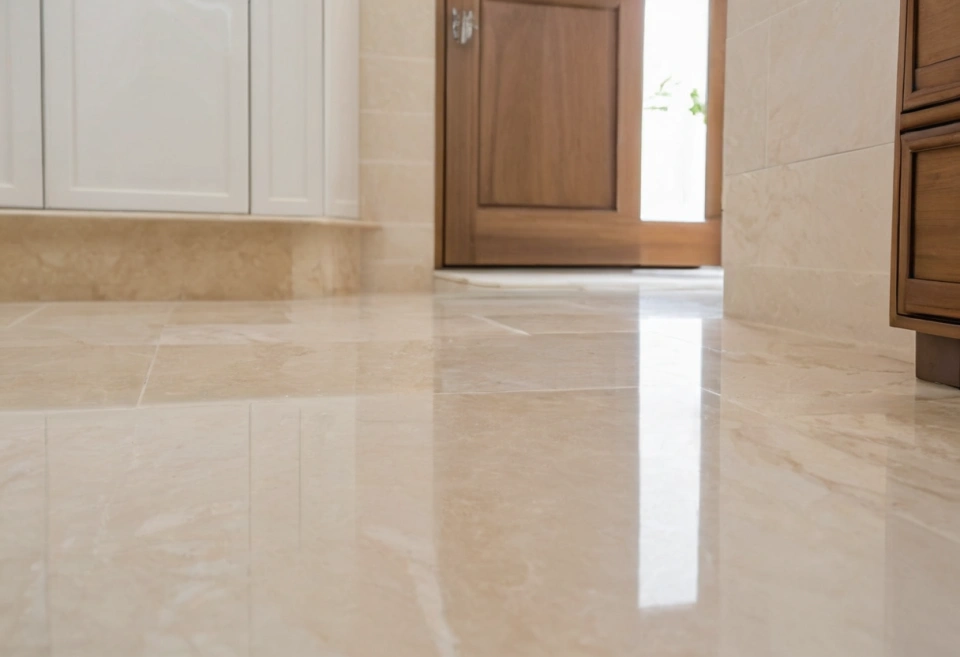
Polished stone reflects. In a Gulf villa with low sun coming off water and pale paving outside, a polished floor turns that light into a second source of glare, and shows dust, footprints and every dried droplet. It also becomes slippery when wet. Polished belongs on walls, vanity tops, table tops and dry reception areas where nobody arrives with damp feet.
Honed is a flat matt finish, ground short of a polish. It hides scuffs and water marks far better and gives more grip underfoot, though a very fine hone on smooth marble can still be slick when soapy. Brushed (sometimes sold as antiqued or leathered) is worked with abrasive brushes so the softer parts of the stone wear back and the surface gains texture. On travertine and limestone this opens the pores slightly and improves slip resistance; on granite it produces a tactile, low-sheen surface that hides smudges well.
- Entrance halls and living floors: honed marble or dense limestone, with a walk-off mat inside the door to catch sand.
- Bathroom floors and shower trays: honed or brushed, in smaller formats so the grout lines add grip and the fall to the drain can be formed.
- Kitchen worktops: granite where cooking is frequent and acidic; marble only if a permanent patina of etch marks is acceptable.
- Terraces, pool surrounds and outdoor steps: brushed or unfilled travertine, or a flamed granite, never polished.
- Feature walls and vanity tops: polished, book-matched if the slab allows, kept out of the splash zone of taps.
Where a bathroom needs to work like a small private spa, the split between wet and dry zones matters more than the stone chosen. The same logic set out in spa interior design for hotels, clubs and private villas in the Gulf applies at domestic scale: keep standing water in a drained enclosure and specify the dry area separately.
What sealing does, and what it does not do
A penetrating impregnator sits in the pores below the surface and reduces the rate at which liquids are absorbed. It buys time. Oil spilled on a sealed limestone counter beads for a while instead of soaking in immediately. That is the whole mechanism.
It does not create a film. It does not stop acid reacting with calcium carbonate, so etching happens on sealed marble exactly as it does on unsealed marble. It does not make a polished floor less slippery. It does not fill the voids in travertine or repair a cracked bed. And it does not last indefinitely: traffic lanes, shower floors and outdoor terraces lose repellency sooner than a guest bedroom floor.
Test rather than guess. Put a few drops of water on the stone in a worn area and watch. If it darkens within a minute or two, the impregnator has gone and the surface needs cleaning, drying and re-treating. Solvent-based products generally penetrate dense stone better than water-based ones; whichever is used, apply thin, wipe off the excess before it dries and ventilate the room. Over-application leaves a hazy residue that is tedious to remove.
Topical coatings and wax are a different decision. They give a sheen and a barrier, but they trap moisture, scuff in traffic lanes and need stripping. On a coastal ground floor with any residual damp in the screed, a film-forming sealer is a reliable way to produce efflorescence and lifting.
Salt air, hard water and acid etching
Coastal air carries chloride. It settles on terraces, balustrades, window sills and the threshold strip where inside meets out. Salt crystallising in the pores of a porous stone can push the surface apart, a process seen on unfilled travertine and soft limestone near the water. The remedy is boring and effective: rinse external stone with fresh water regularly, avoid ponding, and detail sills and copings with a drip so water runs off rather than tracking back underneath.
Inside, the enemy is desalinated water carrying minerals, plus soap. Every droplet left to dry on a honed marble shower wall leaves a deposit. Acidic descalers remove the deposit and etch the stone in the same stroke. Squeegee the walls and floor after use, keep the extract fan running, and clean with a pH-neutral stone cleaner. For an etch mark on a honed surface, a marble polishing powder worked by hand can restore the finish; on polished marble, repolishing is a job for someone with the machine and the grit sequence.
In kitchens, treat marble as a working surface that records use. Bakers like it because it stays cool. Everyone else should expect rings from citrus and wine, and a slow shift in tone. If that is unacceptable, put granite or a quartz composite on the preparation run and use marble on an island that only sees serving.
Laying patterns, joints and falls
Large-format tiles look calm and reduce grout lines, but they demand a flat substrate and full bedding. Any void under a slab in a wet area collects water. Ask for back-buttering and near-complete coverage, and for a screed checked with a straight edge before laying starts.
Pattern changes the reading of a room. Straight stack joints suit a rectilinear plan; running bond softens a long corridor; Versailles or French pattern suits a traditional majlis but generates cuts and waste, so order accordingly. Book-matching two slabs on a wall requires consecutive cuts from the same block and a dry lay before fixing.
Joints are not decoration. Keep a consistent width, typically 2 to 3 mm internally for rectified stone, wider for tumbled or unfilled edges. Carry movement joints through from the screed into the stone, place them at doorways and at changes of plane, and use a flexible sealant rather than grout at perimeters, at the base of a shower wall and around a bath. Grout colour decides whether the floor reads as one surface or a grid; test a sample panel and let it dry fully before approving.
On terraces and in showers, the fall to the outlet must be formed in the substrate, not improvised with adhesive thickness. Where stone paving continues from a shaded terrace towards an outdoor majlis seating area, set the finished levels and drainage channels first so the seating platform stays dry and the stone does not sit in a puddle after washing down.
Day to day care, and what to agree before ordering
Routine maintenance is mostly mechanical. Dry dust-mop or vacuum with a soft head, since sand under a shoe is an abrasive. Damp-mop with clean water and a neutral cleaner, then dry. Change the water often; grey water spread over honed marble leaves a film. Use felt pads under furniture, mats at every external door, and coasters as a habit rather than a rule enforced on guests.
- Name the quarry, bed and finish on the drawings, and approve physical samples under the actual lighting of the room, wet and dry.
- Insist on a dry lay of feature areas and a sample panel showing joint width, grout colour and movement joint positions.
- Confirm substrate flatness, falls, waterproofing and coverage before any stone is fixed, and record it with photographs.
- Agree who seals, with which product, how many coats, and when; get the manufacturer's cleaning instructions in writing.
- Order spare tiles from the same batch, stored flat and labelled, for later repairs.
- Hand over a written care sheet to whoever cleans the house, in the language they read, listing what must never be used on the stone.
Then walk the finished floors with the contractor before final payment: check lipping at joints with a straight edge, tap for hollow sounds, look at the threshold and the shower drain with water running, and note anything that needs correcting while access is still easy.