Outdoor majlis seating and shaded terraces that work in Gulf heat
An outdoor majlis earns its keep only if it is usable for most of the year. Placement, shade structure, fabric choice and a plan for the hot months decide whether it becomes a second living room or an expensive ornament.
Contents
This article is for villa owners and tenants who want an outdoor sitting area that works as an extension of the indoor majlis, and for anyone briefing a landscaper or fit-out contractor on a shaded terrace. It covers placement relative to the house and the sun, roof and screen options, fans and misting, fabrics that survive ultraviolet light and dust, lighting and power, and what to do with cushions when the temperature makes the space unusable.
Where to put the terrace
The most useful thing a house can do for an outdoor room is cast a shadow on it. In the Gulf, the sun tracks high and to the south for most of the year. A terrace on the north face of the building sits in the house's own shade from late morning onward during summer, and catches low winter sun when warmth is welcome. An east-facing terrace gets morning light and shade by early afternoon. West-facing terraces absorb the harshest hours and need the most intervention: deep overhangs, vertical screens or deciduous planting that leafs out in summer.
Before committing to a footprint, stand on the proposed site at three times of day around the summer solstice and note where the shadow line falls. A simple sketch with the house outline, compass points and shadow edges at nine in the morning, noon and four in the afternoon will tell more than any rendering. If the terrace must go on the south or west side, budget for a roof structure deep enough to shade the full seating depth at the lowest useful sun angle, roughly four o'clock in June.
Distance from the house matters too. A terrace pressed against the living-room glass doors gets used; one at the far end of the garden does not, especially when carrying trays of tea and plates of fruit. Keep the route short, level and lit. The logic behind designing a majlis for family and guests indoors, easy circulation and clear sightlines between host and arrivals, applies equally outside.
Roofs, screens and the air gap
A shade structure has two jobs: block direct sun and let trapped heat escape. A flat solid roof without ventilation becomes a radiant panel by mid-afternoon. The fix is an air gap: a second skin above the ceiling, open at the edges so hot air rises and draws cooler air through. Even a simple raised metal sheet standing 100 mm above a timber deck roof makes a noticeable difference to the temperature underneath.
Options, roughly in order of permanence and cost:
- Fixed solid roof with ventilated cavity. Best year-round performance. Needs proper waterproofing, guttering and a fall to drain. Can carry recessed lights and ceiling fans.
- Adjustable aluminium louvres. Open for ventilation, close for rain or full shade. Motorised versions need power and a rain sensor. Check the blade spacing: wider gaps let dappled light through even when closed.
- Slatted timber pergola. Attractive and relatively cool if the slats are spaced to block high-angle sun while allowing airflow. Timber needs oiling or sealing against UV and occasional rain. Does not keep rain off unless a retractable canopy is added beneath.
- Tensioned fabric sails. Cheapest and quickest. High-density polyethylene shade cloth blocks UV but still radiates heat downward. Lifespan is shorter than hard structures; fittings and anchor points need checking after shamal winds.
Vertical screens on the west and south-west edges cut low-angle glare that a horizontal roof cannot reach. Perforated metal panels, timber battens or dense planting all work. Leave gaps at top and bottom so air moves through; a fully sealed wall turns the terrace into a heat trap.
Fans, misting and their limits
A ceiling fan rated for damp locations moves air across skin and makes a shaded terrace feel several degrees cooler without changing the actual temperature. Mount it high enough to clear the tallest standing guest, typically 2.4 m or above to the blade tips, and choose a motor sealed against dust ingress. Brushless DC motors run quieter and draw less current than older AC types, which matters if the terrace circuit is already carrying lights and a socket ring.
Misting systems atomise water into a fine fog that evaporates and cools the surrounding air. They work well in dry heat but lose effectiveness as humidity rises, which is much of the Gulf summer. Droplets that do not evaporate land on cushions, stone floors and electrical fittings.
If misting is specified, keep nozzles away from seating surfaces and power outlets, use a timer rather than continuous operation, and accept that the floor will need a non-slip finish and a drain. Hard water leaves calcium deposits on nozzles; a simple inline filter and periodic descaling keep the system working.
Neither fans nor misting substitute for shade. They supplement a well-placed, well-roofed terrace. Without the roof, they are fighting a losing battle against direct solar gain.
Fabrics, cushions and dust
Ordinary printed polyester fades within a season outdoors in the Gulf. Solution-dyed acrylic fabrics, where the pigment is added to the polymer before the fibre is extruded, resist UV degradation far longer. Specify them by manufacturer name and ask for the outdoor or marine-grade rating. Foam cores should be quick-dry reticulated foam, not standard upholstery foam wrapped in a waterproof cover; trapped moisture inside a sealed cushion grows mould in days.
Dust is the other constant. Smooth, tightly woven fabrics shed dust with a brush or a hose. Textured weaves and loose knits trap it. Removable covers with a zip along one long edge make washing practical. Dark colours show dust; very pale colours show sunscreen and tea stains. Mid-tone neutrals are the pragmatic choice for a villa garden setting where sand and irrigation splash arrive daily.
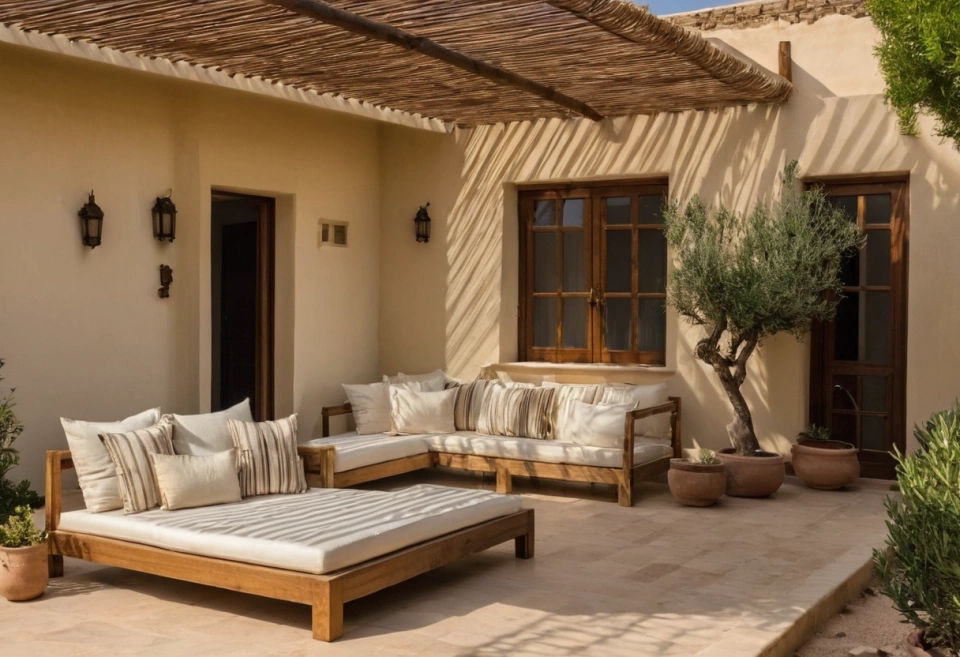
Built-in bench seating with a rendered or stone base reduces the number of loose items that blow around or need carrying in. Only the seat pad and back cushion are removable. Loose chairs and floor cushions multiply the storage problem discussed below.
Lighting and power
An outdoor majlis used after dark needs three layers of light: ambient wash on walls or planting so the space feels enclosed, task light at table height for food and cards, and low-level path lighting on the route back to the house. Lanterns with LED candles give atmosphere without heat or fire risk. Recessed downlights in a solid roof provide general illumination; dim them to a warm colour temperature so faces read naturally.
Power planning is unglamorous but decisive. Run a dedicated outdoor circuit from the distribution board with its own residual-current device. Place weatherproof socket outlets at seated height near the ends of bench runs, not at floor level where irrigation or cleaning water reaches them. If you want a sound system or phone charging, specify the sockets and conduit before the render goes on. Retrofitting cable into finished stone or tile is expensive and visible.
Storing cushions out of season
From roughly June to September, many Gulf terraces are simply too hot for evening use even with fans. Cushions left outside degrade faster in those months: UV, heat cycling and overnight humidity combine to break down foam and fade fabric. A storage plan is part of the design, not an afterthought.
The store needs to be dry, ventilated and close enough to the terrace that carrying cushions is a two-minute job, not a trek. A ventilated cabinet built into the bench base works well: louvred doors allow airflow, a raised floor keeps pads off any condensation, and the depth matches the cushion thickness. Avoid sealed plastic boxes; they trap residual moisture and encourage mildew. If a dedicated store is impossible, a spare room shelf or a garage rack with breathable cotton bags beats leaving cushions under a tarpaulin outside.
Before storing, brush off dust, unzip covers and let foam air for an hour in shade. Stack pads on edge rather than flat so air circulates between them. Check once a month for smell or damp; a musty odour means the store is not ventilating enough.
Next steps before briefing a contractor
- Walk the proposed terrace site at morning, noon and late afternoon in the hottest month available. Photograph the shadow lines. Mark the footprint with tape or spray chalk on the ground.
- Decide the roof type and confirm it can carry fans, lights and, if wanted, a retractable rain canopy. Get a structural check if attaching to the house.
- Write a one-page schedule listing: fabric name and grade, foam type, cushion dimensions, number of loose pieces, storage location and ventilation method.
- Mark socket positions, fan mounting points and light fittings on the terrace plan before any wet trades start. Confirm the outdoor circuit and RCD with the electrician.
- Agree a maintenance calendar: fabric brushing frequency, timber oiling interval, nozzle descaling, cushion storage dates. Put it in writing so it survives the handover.